
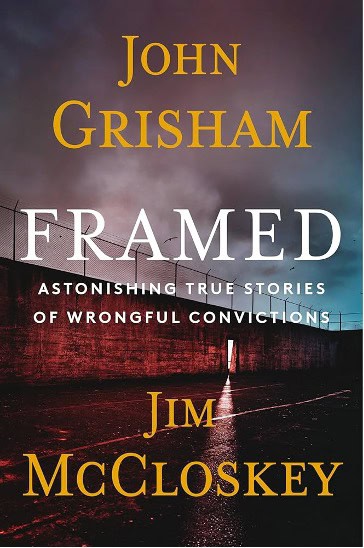
Framed: Astonishing True Stories of Wrongful Convictions
by John Grisham and Jim McClosky
Author John Grisham was a personal injury and criminal defense attorney before becoming an author. He states: “There are still thousands of innocent people in prison and more get locked up every year. The police and prosecutors responsible for wrongful convictions are immune from punishment. Racism is a huge factor at every phase: suspicion, arrest, bail, indictment, trial, and sentencing.”
Grisham and Jim McCloskey, the founder of the nonprofit organization, Centurion Ministries, that works to exonerate wrongfully-convicted people, collaborated on this important and compelling book. Framed has ten chapters. Each chapter relates a frightening true story of an erroneous conviction, caused by perjury, police, prosecutorial and judicial malfeasance, suppression of exculpatory evidence from the defense, and/or other acts obstructing justice (“…they were not caused by unintentional mistakes by local law enforcement or mis-identification by well- meaning eyewitnesses or honest but erroneous forensic analysis.”)Framed is not a leisurely read, although it’s definitely incredibly worthy and extraordinary. I had to read it in small sections since it is so shocking and heartbreaking. This unconscionable and horrible behavior has been happening in real life for decades. Dear readers, please share it with other readers to increase awareness and hopefully prevent these egregious situations from happening.
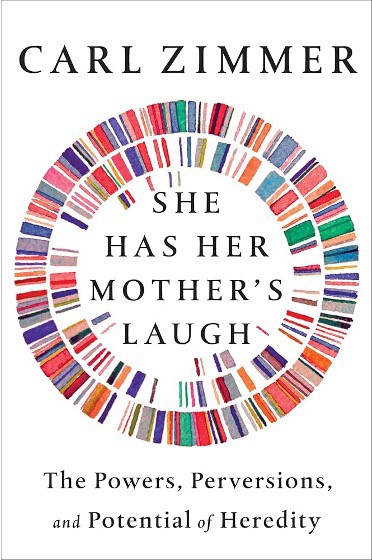
She Has Her Mother’s Laugh: The Powers, Perversions, and Potential of Heredity
by Carl Zimmer
“We are all complex mosaics of many different ethnic groups, with even some Neanderthal DNA thrown in for good measure.” ~ Carl Zimmer
Zimmer, a Professor (Adjunct) of Molecular Biophysics and Biochemistry at Yale University, discusses the history of heredity and genetics including genetic testing and the ethical implications and dilemmas of genetic engineering. His narrative traces the evolution of genetic science from early theories of inheritance to present day discoveries, beginning with Charles Darwin’s contributions, in a readable, not too technical manner. Weaving together current scientific research and historical milestones, with humorous and fascinating anecdotes in order to illustrate specific points and make his book more relatable, he presents intriguing topics.
I was unaware of many, such as genetic mosaicism and microchimerism. Astonishingly, as I was taught and led to believe decades ago, genes aren’t fixed. According to Zimmer, each individual carries fragments of DNA from numerous ancestors. Our bodies are not static. Cells are dynamic and mutate as we live and even carry traces of other people such as cells passed between mothers and their babies, including surrogate mothers. The field of epigenetics, reveals how environmental factors (for example, diet and stress) can influence gene expression through endless generations.
CRISPR technology, a gene-editing technology, raises ethical concerns about genetic manipulation, such as “designer babies.” Zimmer writes about its good points such as defeating inherited maladies, but also warns about its misuse. “In 2015 a reporter asked inventor Elon Musk if he was considering getting into the business of reprogramming DNA. Musk replied ‘How do you avoid the Hitler Problem?’”
“The myth of white purity (as promoted by the Nazis) has endured even after the study of ancient DNA has proven that Europeans have inherited genes from wave after wave of migrants – people with ancestries separated by tens of thousands of years of history, mixing their genes together. “
There is much to consider after reading this engaging, enlightening book. I hope you enjoy it!!! From The Smithsonian Magazine: Carl Zimmer is the award-winning New York Times columnist who has been hailed as “the country’s most respected science journalist.” He is the author 14 previous books, including Parasite Rex. Zimmer contributed to the coverage that won the New York Times the Pulitzer Prize for public service in 2021.
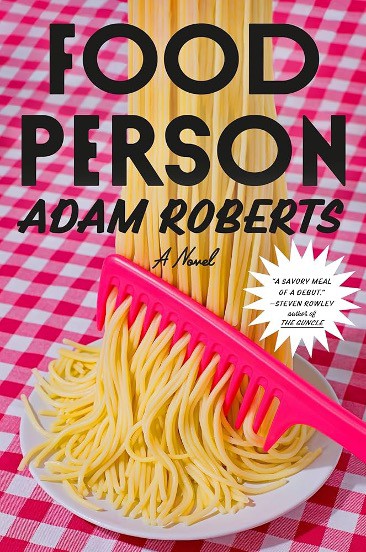
Food Person
by Adam Roberts
“The place where she felt the most confident – where she knew who she was, where she knew she felt completely in command and utterly herself – was at the stove.”
In this endearing debut novel by food writer and blogger Adam Roberts, Isabella Pasternak, a frumpy, socially-awkward, yet talented twenty-something food writer – after demonstrating a catastrophic live-streamed chocolate soufflé demonstration at her job at a food magazine and being fired in the aftermath – accepts a job ghostwriting a cookbook for Molly Babcock – a has-been, self-absorbed actress hoping to reclaim her former celebrity status.
In the course of attempting to write Molly’s cookbook, Isabella accompanies Molly to New Jersey to rescue a binder filled with Molly’s mother’s recipes, which Isabella hopes to include in her memoir-filled cookbook. Despite Molly’s arrogance, lack of cooking skills, and total disinterest in food, Molly and Isabella, eventually become friends. As Molly learns and accepts herself and works through past traumas, she begins to enjoy food and begins to nourish herself – just as we readers nourish our minds by reading books! Meanwhile Isabella gains new confidence in her passion for ghostwriting Molly’s cookbook.
I enjoyed reading Food Person immensely and appreciate Robert’s witty, heartfelt narrative, and insight. From Penguin Random House: Adam Roberts is the author of The Amateur Gourmet, Secrets of the Best Chefs, and Give My Swiss Chards to Broadway. He started his food blog The Amateur Gourmet in 2004, and also hosts the podcast Lunch Therapy. Roberts has also written for The Washington Post and The Los Angeles Times, and for film and television. He lives in Brooklyn with his husband and their dog Winston.
Adult book reviews are by Susanne Dominguez.