
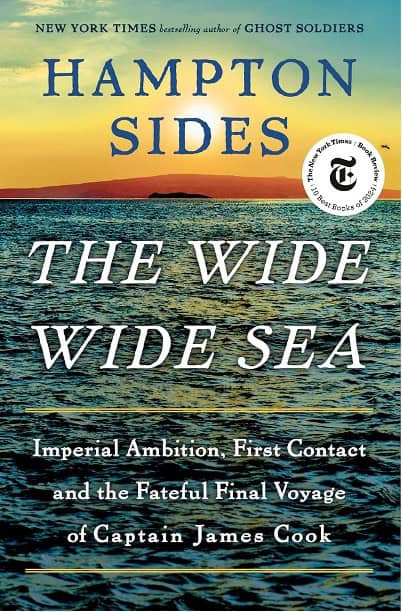
The Wide Wide Sea: Imperial Ambition, First Contact and the Fateful Final Voyage of Captain James Cook
by Hampton Sides
He wanted to go not only “farther than any man has been before me, but as far as I think it possible for an to go.” ~ James Cook, a man of his time
Captain James Cook sailed a total of 200,000 miles, during his three voyages. As an outstanding surveyor, hydrographer, and cartographer, he provided documentation of the maps he created that navigators used for centuries. In this meticulously researched chronicle, Sides studied numerous primary sources to write a phenomenal tour de force. Among the primary sources are journals penned by the crews on Cook’s ships.
Sides’s masterful narrative is focused on Cook’s final and third expedition, which led to his death in February 13, 1779, at Kealakekua Bay on the Big Island of Hawaii. Cook’s “official” mission was to return Mai, a Tahitian man who became admired and famous in London, after arriving as a guest from Cook’s second voyage. Cook’s instructions were to return Mai, at Mai’s request, to his home in Tahiti. However, Cook was also secretly commanded to both chart and claim land for the British Empire and to discover the fabled Northwest Passage. This was his primary mission.
By 1775, 48-year-old Captain James Cook had completed two successful voyages of exploration and had earned a rewarding retirement. However, he apparently became bored in retirement and in 1776, he departed on a third voyage, on the HMS Resolution. Over three years, he sailed from England to Cape Town, South Africa, Tasmania, New Zealand, Tahiti, and other tropical islands. On his way to Alaska, he discovered Hawaii, which no one in England knew existed. He sailed along the coastline of the Oregon Territory and Alaska, journeyed as far as he could before being stopped by solid ice fields in the Bering Strait and the Arctic Circle, and he then returned to Hawaii via the Bering Sea, where he died.
Despite the controversy and aspersions cast nowadays on Cook, he attempted to understand the cultures he encountered, instead of considering them inferior. He refused to physically punish his crew and the indigenous people of infractions initially, until his crew vehemently protested. Admired for his humane leadership and respect for indigenous peoples at that point in time, especially compared to other explorers, he displayed a violent temper on his final voyage. Perhaps his irrational behavior was due to his age and frustration with the expedition’s challenges, such as constant the inclement weather and violent hurricanes, ice fields, health issues suffered by the crew such as tuberculosis, accidents, and several violent interactions with indigenous peoples. His ships were the only ones unaffected by scurvy (a dreaded maritime disease), because Cook believed the crew needed to eat fresh produce. He didn’t understand why, but it worked! (The disease is cured by eating citrus fruits.) Unfortunately, “nearly two million European sailors perished from scurvy between 1600 and 1800.”
His initial curiosity and goodwill could sometimes descend into violent attacks in the heat of the moment, perhaps caused by miscommunication. Cultural values between the indigenous people and the British were very different, as you can imagine. Then there was the language barrier they had to contend with. Sides provides significant historical context to the 18th century era (colonialism, moral values, religious beliefs, traditions, etc.)
Captain Cook believed that a group of indigenous people he met “were happier than Europeans because they enjoyed social equality in a warm climate and were provided with all the necessities of life, and therefore had no need of trade with Britain, contrary to the popular belief in Britain and among Cook’s crew members that indigenous people were savages living in societies inferior to British civilisation.”
A riveting and informative historical account of Cook’s journeys, Wide Wide Sea provides a spellbinding read. I always look forward to reading books authored by Sides. Another very rewarding and entertaining book readers may wish to read also about Captain Cook, is Blue Latitudes: Boldly Going Where Captain Cook Has Gone Before by Tony Horowitz. Horowitz writes about his experiences physically retracing Cook’s voyages. I found it delightful with a unique perspective. Sides includes it in his bibliography.
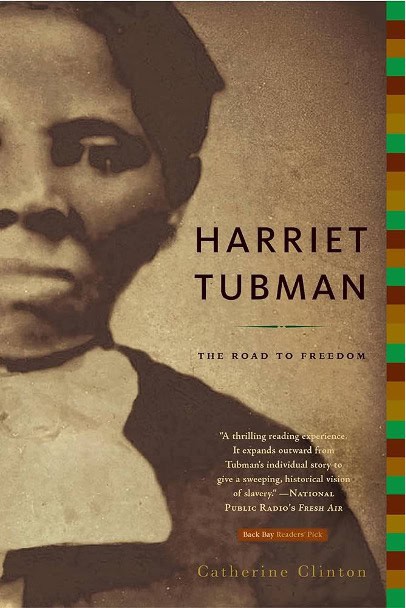
Harriet Tubman: The Road to Freedom
by Catherine Clinton
Harriet Tubman was one of the most extraordinary and courageous persons in United States history, especially during the time leading up to and during the Civil War era. She was called both “Moses” and “the prophet” by enslaved people she rescued. Tubman spirited them north to Canada and U.S. states where slavery was illegal.
She was the only woman, the only Black person, and an escaped fugitive slave to work as a conductor on the Underground Railroad. A huge bounty was placed on her head by angry slave owners because she rescued so many slaves. According to historyfacts.com, Tubman emancipated over 700 people. During the Civil War, she was the only woman to officially lead men into battle. Incredibly, she acted as a spy and a scout during the Civil War while serving with the Union Arm’y in South Carolina. To John Brown the well-known abolitionist, she was “General Tubman. To slave owners, she was “the enemy.”
Raised on the Eastern Shore of Maryland in the 1820s, not far from where Frederick Douglass was born, her birth name was Araminta Ross. She later changed it to Harriet Tubman after marrying. Her early life was heartbreaking. As an enslaved child, she was horribly abused by her owners. Although she was illiterate (slaves were not allowed to be educated), Tubman achieved astonishing, almost miraculous accomplishments. Her contributions throughout her life were so remarkable that Susan B. Anthony introduced her as a “living legend” at a New England Women’s Suffrage Association conference in 1897. After retiring from government service, she received a small pension which she used to establish her own charitable organization. In 1908, she opened The Harriet Tubman Home, which housed and sheltered African-American people in need. Harriet Tubman died on March 10, 1913 and was buried with military honors. Clinton’s well researched biography of this brilliant, incomparable, and selfless woman is both compelling and enlightening. Harriet Tubman is truly a hero for the ages and a champion for the rights of Black people and women’s suffrage. I highly recommend this rewarding book.

The Final Problem
by Arturo Pérez-Reverte
A witty, tongue-in-cheek mystery inspired by Conan Doyles’s Sherlock Holmes novels, the story occurs in June of 1960 during a fierce, unexpected storm which forces a luxury yacht’s occupants, including our protagonist, Basil Ormand (think Basil Rathbone, the celebrated actor whose portrayal of Sherlock Holmes is legendary) to evacuate to the only available accommodation, the Ausländer, a picturesque small 19th century villa, on the nearby island of Utakos, near Corfu. They end up being stranded for much longer than they anticipated. Other tourists find themselves also stranded and join the yacht’s former occupants, for a total of nine tourists at the hotel.
When one of the tourists is murdered, everyone urges Ormand, an actor past his prime, to investigate since they think he must know how because he portrayed Sherlock Holmes in numerous movies. Of course, Ormand demurs, but eventually is talked into it because there is no police presence on the island and it will be many days before any authority can arrive.
A playful novel, it incorporates the glamour of Old Hollywood and name drops celebrities such as Errol Flynn and David Niven, and renown authors of the era, Graham Green and Patrick Leigh Fermor. As with Pérez-Revert’s engaging previous novels, which are quite different, this is an entertaining read sure to keep you focused to discover the unanticipated denouement. The novel is a translation from the original Spanish.
From Wikipedia: Arturo Pérez-Reverte Gutiérrezis a Spanish novelist and journalist. He worked as a war correspondent for RTVE for 21 years (1973–1994). His first novel, El húsar, set in the Napoleonic Wars, was published in 1986. He is well known outside Spain for his Captain Alatriste series of adventure novels, which have been translated into multiple languages. Since 2003 he has been a member of the Royal Spanish Academy.
Adult book reviews are by Susanne Dominguez.